
Ask A Publisher
By Kathy Nguyen


Image Caption; Kathy Nguyen in Lisbon, ready to embark on some grand London adventures!
Dear Desperate Writers,
I should preface this column by saying I am not your one-stop publishing expert. I’ve worked in traditional publishing for some years now across production, rights, and, more recently, editorial in Canada and the UK, but there are many aspects of publishing that I have yet to learn. My hope is that this column will introduce some transparency to an industry that seems to generate a lot of intrigue, but remember that, ultimately, your publishing journey is unique to you. Nothing here is meant to be prescriptive—merely to serve as a beacon if I’m lucky enough to have done my job right. So, without further ado, let’s jump into our first question:
Why does publishing take so long? In a world where everything is speeding up, why does it take years for a book to be published, once it’s accepted?
It might go by different names, but all of us publishing professionals are, bottom line, obsessed with what’s known as the “critical path,” which outlines all the key deadlines you need to hit and the timeframe that’s required to hit them for your book to be published successfully. Success, in this case, doesn’t mean so much whether your book will do well sales-wise, acclaim-wise—we try, yet the equal parts agonizing and bewitching truth of this industry is that no one can truly predict the whims of the market—but whether the publisher has done everything they can to make your book ready for these possibilities.
What does that look like? Many things! Some of the more recognizable markers of good publishing: ensuring your book goes through its rounds of editing, copyediting, and proofreading (nothing is so loathsome as a typo in print!); maintaining to-press dates with printers that take into account when you’ll need stock shipped to warehouses for orders (this becomes a bigger deal when your book is printed overseas instead of domestically); and notifying retailers that your book will soon be on the market. But there are other aspects of publishing that perhaps aren’t as well-known, although they matter just as much in setting up your book for success. Some of these include—but are by no means limited to—selling translation rights so your book can be made available internationally, determining the right packaging from figuring out the wording of your cover copy (i.e. the book description you read on the jacket flap or back cover) to the cover design, and pitching your book to news outlets/podcasts/literary festivals/influencers/etc. to generate added publicity.
You’ll find, then, that publishing rears many heads, all of which need to work more or less in sync, to get that one book on the shelf. Collaboration takes time, if we can recall those halcyon school days (you can read me as being facetious here) and the end-of-term group projects you’d inevitably have to start beginning- or middle-of-term. And publishing is, at its core, a collaborative process, both within the publishing house—consider your editorial, operations, marketing, publicity, sales, rights, production, audiobook, and finance teams, to name a few compatriots—and outside of it, with retailers, libraries, and various forms of book advocates. Once the book is finished for my team then, it’s still not “finished, finished” yet; other teams might be working their sorcery on it still or are just about to have it passed over to them. Each of us is operating on a specific schedule, with a not insignificant number of items to check off the to-do list. Each of us has a mini critical path to make up the larger one.
I’ll elaborate on the editorial side of things, since that’s where I work now. For a standard black and white (or “mono”, as we tend to call it in the UK) book, you’ll go through a few revisions with your editor—a book is acquired on its polish, yes (so please don’t skimp out on a rigorous self-edit/proofread before you query agents and/or publishers!), but more so, I find, on its promise; I’ve yet to encounter a book that was ready for print as soon as the contract was signed. Once those structural edits are done, with you and the editor happy with the book’s overall shape, your book will need to undergo a copyedit, which screens for readability and consistency, and, after a quick handover to the production team for typesetting (i.e. arranging the text for print), a proofread, which catches any remaining errors. Depending on the genre of your book, by which I generally mean if you’re writing non-fiction or even auto-fiction, your book might also need to go past a legal read as well as some sort of fact-checking process, and if you want end matter like an index or citations page, that will need to be factored into the schedule too.
All things considered, the critical path for adult trade publishers, provided their focus is not solely on producing mass market paperbacks, which can follow a different model of publishing, typically spans two years from the time of acquisition to release. But if you monitor your Quill & Quire (Canada), Publishers Marketplace (US), and/or The Bookseller (UK) deal announcements closely, you’ll find, of course that there are exceptions to this rule. Sometimes books take longer at the editorial stage, among other extenuating circumstances at that will put a book’s publication on hold. Other times a deal will be announced—and the book will come out fast. Crash schedules are possible; critical paths can be shortened. This happens more so in the commercial sector, where you’re looking to publish alongside a cultural trend or topical conversation point. But accommodating crash schedules takes a tremendous, concerted effort from your publishing teams, and if it’s not already built into the publishing model, forcing too many books to publication quickly, if only for the sake of it, can be unsustainable. Bear in mind that your book is one of several on a list your publisher is trying to juggle to be profitable as a business; the fewer curveballs thrown at staff trying to stay on the critical paths for their books makes it likelier that they can publish all of them—and, yes, yours—well.
Publishing is slow, but I hope you can see that that “slow” (read: manageable) pace is set for a lot of good reason. And, as a senior colleague once pointed out to me, workload-wise, these days there’s just so much more to do. In the advent of the internet, more things than ever are vying for our attention. Reading, as a result, seems to have fallen to the wayside. Just this year in the UK, for instance, the literacy charity the National Reading Trust launched their National Year of Reading campaign to combat a steep decline in reading rates across both children and adults. Publishers are working harder to make their books stand out among all the distractions of our increasingly digital lives, and even to justify reading as being worthwhile of our time. It’s an uphill battle, and it isn’t going to end anytime soon. So, if you’re going to be writing for publication, my best advice would be to keep reading, doing your part in ensuring this industry remains healthy for your book and others like it to thrive, and if your book is en route to getting published, congratulations and also: have patience. Publishing isn’t solely about hitting that publication date; it’s all the steps before, after, and in between.
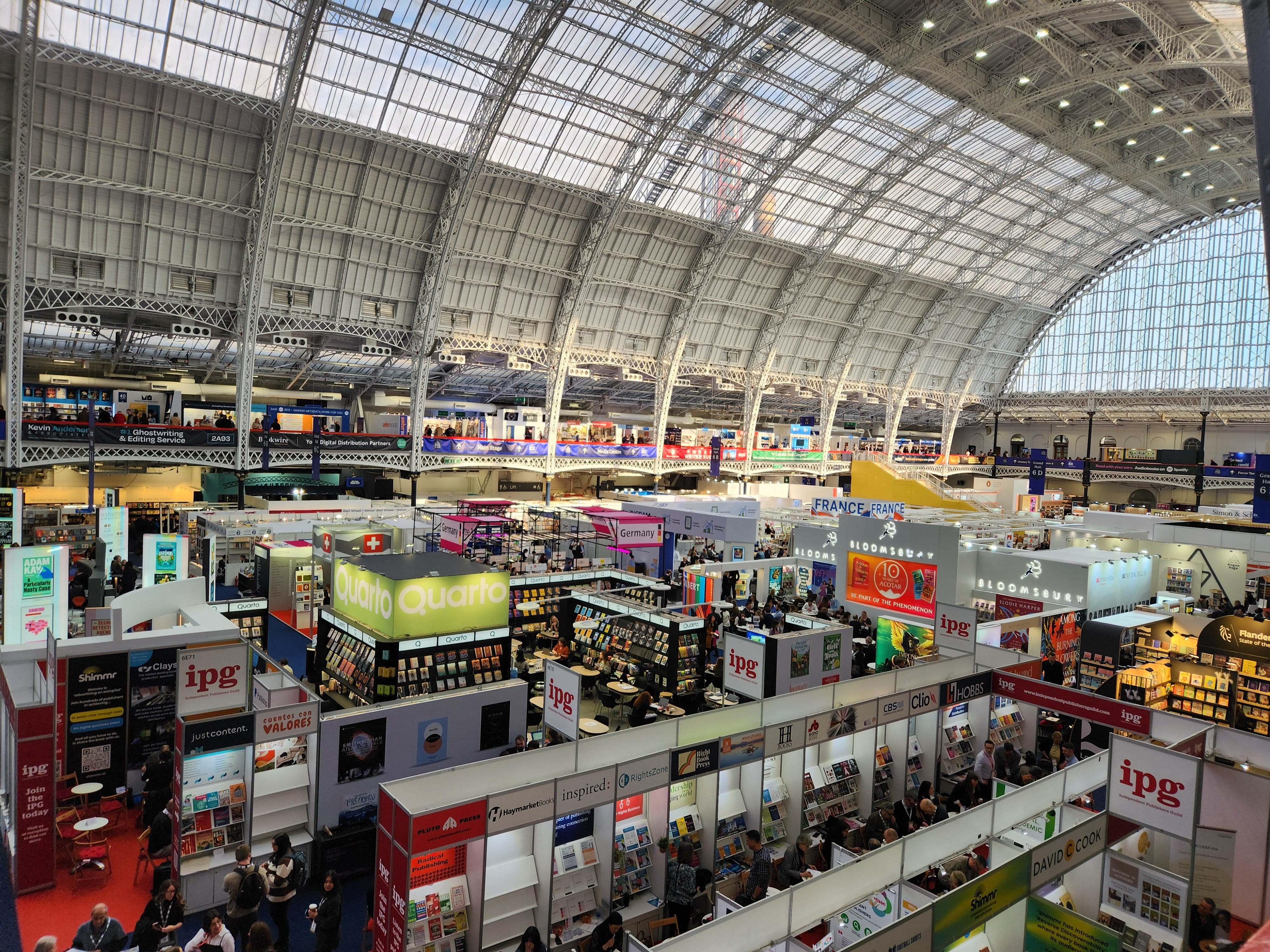
Image caption: The London Book Fair (LBF) is one of the major publishing conventions attracting publishers, scouts, agents, and even authors from around the world (although the Frankfurt Book Fair lays claim to the convention that is the biggest and most renowned). LBF generally takes place in March and is a networking and rights selling affair spanning three intense, meeting-packed, party-packed days. Leading up to the event, you can hear the frantic rustling of paper and clacking of keyboards from all of us publishing professionals trying to get our catalogues and sample materials ready for our excellent rights teams to pitch!
Love this behind-the-curtain look at the world of publishing. Fascinating albeit a tad depressing to think that our digital lives have overtaken our ability/desire to read an actual book.
THANKS FOR WRITING THIS.